
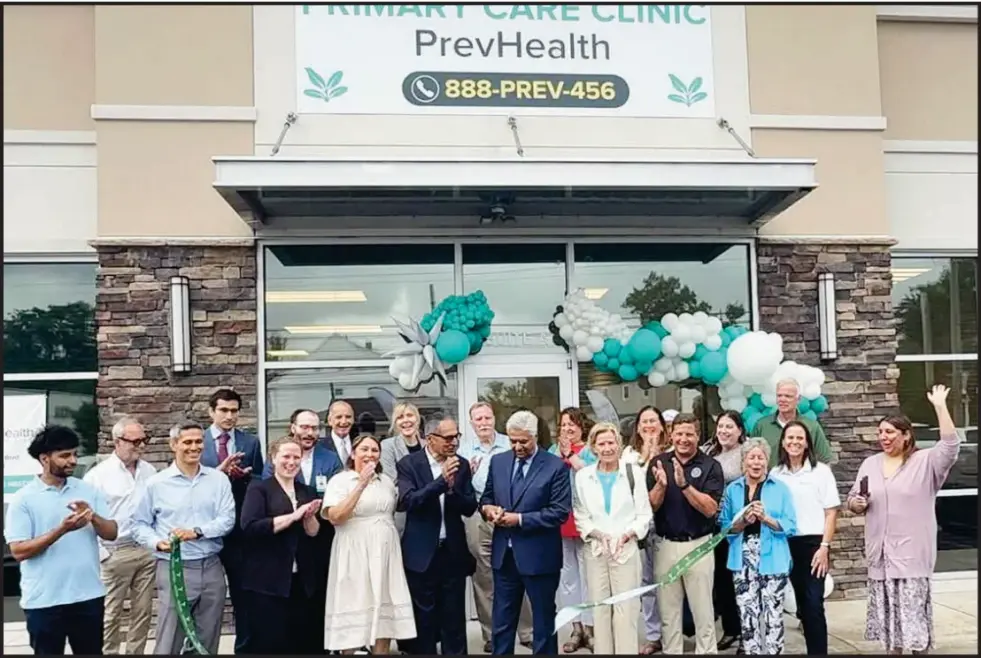
A New Primary Care Clinic in Folsom
A new healthcare clinic that combines artificial intelligence (AI) with nurse practitioner (NP) led care has opened on MacDade Boulevard in Folsom, bringing primary and preventative care to a community that has faced a significant lack in local healthcare access since the closure of Crozer-Chester Medical Center last year.
PrevHealth, led in part by Swarthmore resident Sam Sidiqi, is using the new clinic to provide patients with primary care while incorporating remote patient monitoring and using AI to support medical professionals and help identify potential health problems before they require more serious treatment.
Sidiqi said the goal of the company is to address what he considers to be one of the biggest problems with the American healthcare system.
“In the U.S. especially, we call it healthcare, but in reality, what we have is sick care,” Sidiqi said. “We wait for people to get really sick, and then we have massive interventions in the hospital.”
Remote Monitoring and Early Intervention
Sidiqi said PrevHealth was founded on the idea that AI could allow healthcare providers to monitor more patients and identify problems before they become health emergencies.
“Using RPM, remote patient monitoring, you can track how you’re doing in a lot of ways,” Sidiqi said. “You don’t have to wait for your annual checkup with a doctor… we can look at how your body is doing all the time and make adjustments.”
The company plans on using RPM devices such as smart watches, scales, and smart pill boxes to track measurements such as blood pressure, heart rate, medicine intake, and oxygen levels.
Rather than requiring a patient to wait for an annual appointment to discuss changes in their health, Sidiqi said the AI that PrevHealth uses can flag unusual readings or missed medications, allowing the clinical team, or a nurse practitioner (NP), on site to focus its attention where and when it is needed.
“If we aren’t doing preventative care, then at some point, somebody will show up in an ER with a really big problem,” Sidiqi said. “That’s obviously bad for them in many ways. Generally that person has a worse outcome than they might have had if they’ve been checking up on things.”
AI Supports the Clinical Team
Sidiqi emphasized the technology is not intended to replace medical professionals. The Folsom clinic, for example, is led by a NP, with physicians providing oversight. AI is used primarily as a handbook, monitoring system, and tool to support practitioners.
The AI system can help the NP access medical research and medical journals while considering a patient’s symptoms and history. The final medical decision, Sidiqi says, remains with the NP.
“AI isn’t making any decision; the nurse practitioner makes the decision, but that nurse practitioner knows they have the support of all of the medical journals and everything that’s well researched,” Sidiqi said. “The technology allows the practitioner to see multiple patients in a cost-effective way.”
Sidiqi said the company’s main goal in implementing AI technology is to simply give healthcare workers more time to interact with their patients, rather than eliminate the human components of medicine.
“We’re not trying to get rid of people,” Sidiqi said. “We’re just trying to be able to serve people who aren’t being served, and really give support to have a really good human interaction and to create better healthcare outcomes.”
Expanding Access to Rural Communities
Sidiqi envisions PrevHealth being particularly important in rural communities, where a shortage of doctors may make it difficult to sustain traditional medical practices.
“The average age of rural physicians is about 55 years old,” Sidiqi stated. “So we know that in the next 10 years, there’s going to be a lot of retirees, and there aren’t enough new doctors who are going rural.”
Sidiqi said a model that pairs a NP with AI could allow PrevHealth to operate in communities where a traditional physician’s office may not be financially viable.
“We can also go to rural areas where a doctor can’t afford to run a practice with all their student bills,” he said. “We can then enter and serve with a nurse practitioner, and suddenly, all these people are going to get service they couldn’t get before.”
Protecting Patient Information
While the innovative model could prove helpful in underserved communities, it also raises questions about how PrevHealth plans to protect sensitive patient health information. Sidiqi said patients do not need to be worried.
“The first action that happens when we do the transcription software is we go in and we scrub out patient information, so that what’s going into the AI won’t have any identifier,” Sidiqi explained. “Right away, the first thing centered is HIPAA compliance, and that’s at the forefront of everything we’re doing.”
Technology That Supports People
Sidiqi’s interest in the technology and how it can be harnessed extends far beyond PrevHealth. He has argued that AI should be used to make people more capable rather than replace their work, describing computers as tools that can make the human mind more effective.
“My thesis advisor at MIT, he used to say that computers should be like bicycles for the mind,” Sidiqi said. “And so I think that’s where the U.S. is heading in a wrong direction–– we keep on trying to make the replacement of human intelligence. We shouldn’t be trying to replace humans, we should be saying, ‘Hey, what are the things that we can do to make the human brain more efficient?’”
Plans for More Clinics
Sidiqi’s philosophy is perhaps reflected best in PrevHealth’s long-term plans. Sidiqi said the company has broad aspirations, with plans to eventually establish hundreds of AI-backed healthcare clinics across the country, with a focus on rural communities and areas that are left without accessible primary care.
The Folsom location is only the first of several clinics that PrevHealth hopes to establish in the region. Sidiqi said PrevHealth is looking at additional locations in Pennsylvania, Delaware, and New Jersey, while also expanding into other parts of the country. The company has already opened another clinic in Pilot Point, Texas, a rural community north of Dallas, and is looking toward Oklahoma as another potential market.
While AI has become a growing part of the healthcare industry, Sidiqi said PrevHealth’s approach is different because the company is attempting to build the technology directly into the operation of physical clinics rather than simply sell AI software to existing healthcare systems.
Learning from the Swarthmore Community
Sidiqi said his work with PrevHealth has also given him a greater appreciation for the community he calls home. He said his involvement in the healthcare industry has led to several chance encounters with Swarthmore neighbors who have helped him better understand the field and its challenges.
“One of the top FDA lawyers in the U.S. lives here in Swarthmore,” Sidiqi said. “We have somebody who does amazing work leading in healthcare innovation from a regulatory perspective, and then we have a number of amazing doctors, so getting involved in this, it’s taught me a lot of humility in terms of just realizing how much knowledge my neighbors in Swarthmore have that I’ve been able to to learn from.”
Source: The Swarthmorean.